Allapattah Dealers et al v. Exxon
A ten-year class action battle by 10,000 gas station dealers against one of the world's largest corporations — and a unanimous jury verdict for $1 billion.
"I felt betrayed because I felt I had a partnership with Exxon. When I discovered what they were doing, it was like a man discovering his wife in bed with someone else."
Gonzalez, a Cuban immigrant who purchased his Allapattah station in 1988, lost $60,000 in his first two years — years Exxon was withholding the discount it had promised.
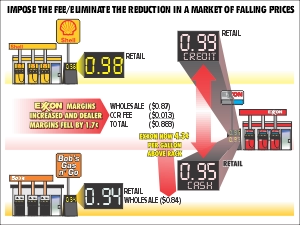
In the early 1980s, Exxon began charging its gas station dealers a 3 percent surcharge on every credit card transaction to cover processing costs. To help dealers absorb these mounting fees, Exxon made a promise: dealers would receive a fuel discount of approximately 1.3 cents per gallon of gasoline to offset the charges.
The dealers relied on that promise. Many of them — immigrants, small business owners, people who had invested their life savings into an Exxon franchise — took out second mortgages and dipped into personal accounts to stay afloat. Exxon, meanwhile, assured them the discount was built into their invoices. They insisted it was a trade secret. They couldn't show the math. Dealers had no way to verify it — and for years, no way to prove the discount wasn't there at all.
In November 1990, Exxon invited a select group of dealers to its National Dealers Advisory Council in Houston — a gathering of station owners and top executives designed for golf, bonding, and polished corporate hospitality. Alberto Gonzalez, owner of a station in Allapattah, Florida, was among those hand-picked to attend.
Then something unexpected happened. A newly appointed Exxon fuel product manager named James L. Carter — apparently not yet versed in the company line — admitted to the assembled dealers that they had not, in fact, been receiving the promised discount. He pledged they would get it going forward.
The room went quiet. Then it went angry.
Gonzalez and fellow dealer Bill McGillicuddy flew home and found Miami attorneys Sidney Pertnoy and Jay Solowsky, who had a track record fighting oil companies. In 1991, they filed a class action lawsuit on behalf of all Exxon dealers nationwide. The fight had begun.
Exxon, for its part, cancelled the National Dealers Advisory Council — a program that had run for 28 years — just five months after that meeting. It never held another one.
Exxon fought the litigation at every turn. The discovery period alone stretched four years. When courts ordered Exxon to produce the data showing how it set gasoline prices, the company delivered the records on tape in APL — an arcane computer programming language used in the 1970s. Converting the data into a usable modern format cost the plaintiffs' attorneys several hundred thousand dollars out of pocket.
The attorneys — who added Miami trial lawyer Eugene Stearns to the team in 1996 — pressed on, spending their own money, fighting motion after motion, and building the case piece by piece. When the pricing data was finally decoded, it told a clear story:
- The discount was not being given to dealers. Except at the very beginning of the program, the promised 1.3 cents per gallon discount had simply not been passed through to dealers' invoices. The data proved it. For years, dealers had been absorbing credit card costs that Exxon had promised to offset — while Exxon captured the margin.
- Exxon had a secret plan to thin its dealer network. At trial, the plaintiffs' attorneys revealed an internal Exxon business strategy to deliberately reduce the number of its own gas stations. Over the 12 years the program was in effect, more than 8,000 dealers went out of business. The network shrank from 10,000 stations to fewer than 2,000. The financial squeeze on dealers — the undelivered discount among the causes — was not incidental. It served a corporate purpose.
- A verbal agreement is still a binding agreement. Exxon argued that the oral promise was not legally enforceable. The jury disagreed. The court held that even for a corporation with more than $230 billion in annual revenue, a spoken commitment to its dealers carried the force of contract.
The first trial in 1999 ended in a hung jury. A second trial began on January 16 of the following year and lasted six weeks, with complex expert testimony on pricing structures and damages methodology. On the final day of deliberations, the jury returned a unanimous verdict for the dealers: $500 million in damages.
With interest added to the $500 million damages award, the total judgment came to $1 billion — one of the largest commercial verdicts in Florida history at the time. The verdict was hailed as a vindication for small business owners everywhere: proof that even a global energy giant with unlimited legal resources could be held to its word by an ordinary jury.
Exxon announced it would appeal. Plaintiffs' counsel expressed confidence the verdict would stand. The case had taken a decade — but the dealers had won.
Legal‑eze handled all Trial Graphics and trial presentation for the dealers' legal team. A case of this complexity — six weeks of trial, 10,000 plaintiffs, arcane pricing data, and a corporate defendant with unlimited resources — required exhibits that could take abstract financial injury and make it viscerally real to a jury. Our work included:
- Pricing and discount exhibits. Visual breakdowns of how the 3 percent credit card surcharge worked, what the 1.3-cent-per-gallon offset was supposed to look like in dealer invoices, and the gap between what dealers were owed and what they received — year by year, gallon by gallon.
- Timeline of broken promises. A chronological narrative of the dealer program — from the original discount promise in the early 1980s, through the years of non-payment, to the candid November 1990 admission, to the filing of the lawsuit — built to walk a jury through a decade of conduct clearly and efficiently.
- Dealer network reduction exhibits. Charts and maps illustrating the collapse of the Exxon dealer network — from 10,000 stations to fewer than 2,000 — and the human cost behind the numbers.
- Financial damages summary exhibits. Translating complex expert damages models into clear, jury-friendly graphics that showed the total unpaid discount, the compounding of that harm over time, and the basis for the $500 million damages figure.